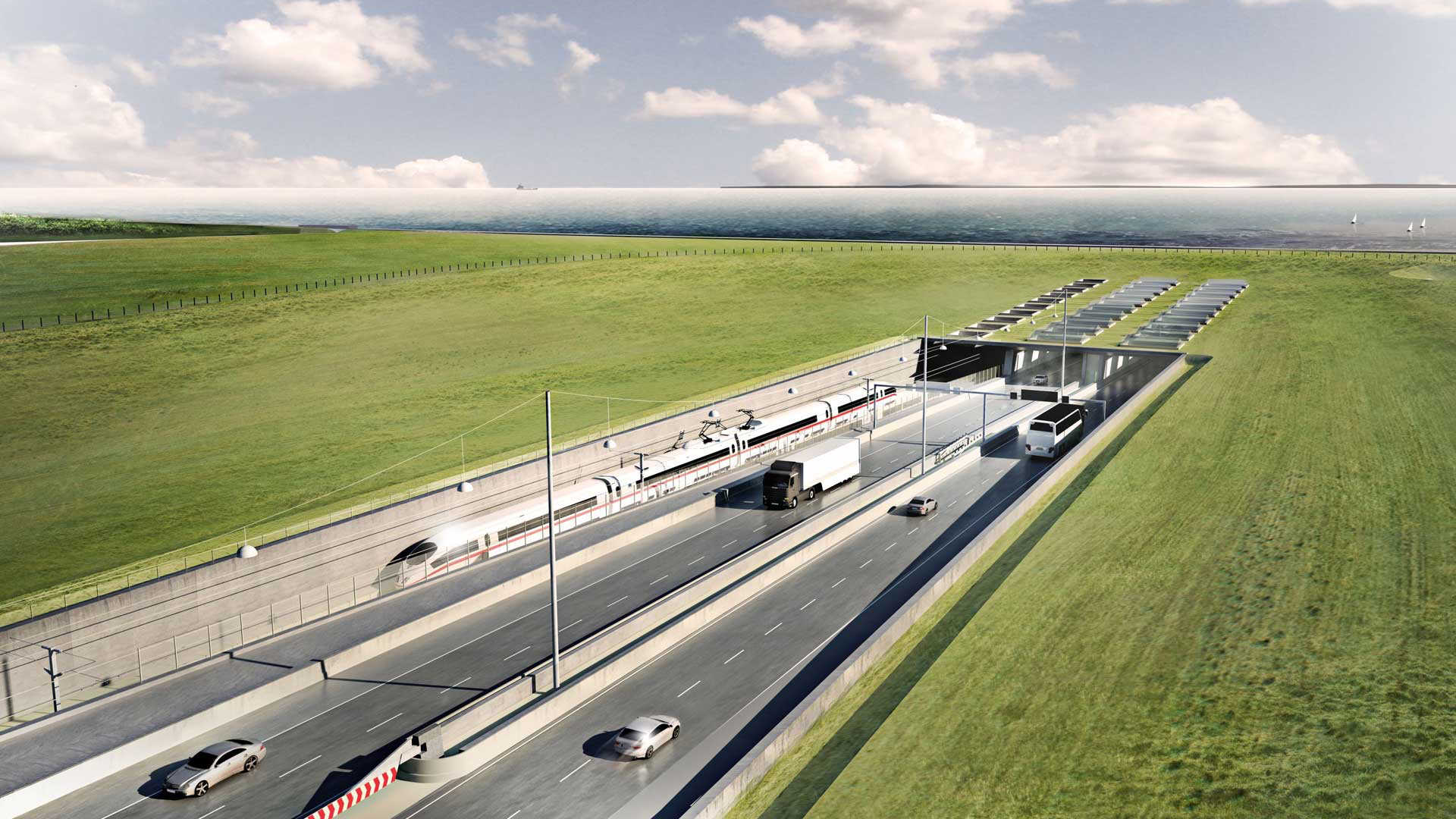
Fehmarnbælt Tunnel
The Fehmarnbælt Tunnel is creating the foundation for a new industrial development opportunity in southern Denmark. In Rødbyhavn, the infrastructure established for tunnel-element production includes large-scale production facilities, a work harbour and extensive areas with future potential for logistics, manufacturing, energy and maritime activities.
Located between Scandinavia and continental Europe, Femern Port & Industrial Park combines existing industrial infrastructure with port access and proximity to the E47 European transport corridor.
A State-Backed Industrial Platform
The Fehmarnbælt Tunnel is one of Europe’s largest infrastructure projects and is being delivered by the Danish state through Femern A/S.
Construction has established a major industrial production site in Rødbyhavn, including large-scale production halls, specialised facilities, a work harbour and supporting infrastructure.
The Danish Parliament has decided that the state will retain the production site after completion of tunnel-element production, creating the basis for its future industrial use.
This provides a significant starting point for the development of Femern Port & Industrial Park and for attracting industrial activities requiring substantial space, specialised infrastructure and access to European markets.
From Tunnel Construction to Industrial Opportunity
The opportunity in Rødbyhavn differs from a conventional greenfield development.
Major industrial and maritime infrastructure has already been established as part of the Fehmarnbælt Tunnel project. The future development of the site can therefore build on existing assets rather than starting entirely from undeveloped land.
Key advantages include:
- State ownership of the existing production facility
- Large-scale production and industrial infrastructure
- Dedicated work harbour and maritime facilities
- Extensive surrounding development areas
- Direct access to the E47 European transport corridor
- Strategic position between Scandinavian and continental European markets
- Location in a region with significant renewable-energy production
A New Industrial Node in Northern Europe
The Fehmarnbælt Tunnel will establish a direct road and rail connection between Denmark and Germany, creating a new transport corridor between Scandinavia and continental Europe.
For Lolland-Falster, this strengthens an already strategic location by combining international road and rail connectivity with commercial ports, industrial land and established production infrastructure.
Femern Port & Industrial Park can therefore develop as a location for cross-border logistics, production, maritime activities and industrial supply chains serving both Nordic and continental European markets.
Industrial Synergy Opportunities
The existing facilities, work harbour and surrounding development areas provide potential for several industrial applications.
Maritime & Defence
- Shipbuilding, maintenance and repair activities
- Existing dry docks suitable for large-scale maritime operations
- Potential for specialised maritime, naval and dual-use activities
Energy
- Manufacturing and assembly for the offshore wind supply chain, including foundations, towers and other large components
- Potential decommissioning, recycling and circular-economy activities
- Potential synergies with Power-to-X and carbon capture infrastructure
Manufacturing
- Large-scale production halls suitable for industrial manufacturing
- Potential for prefabrication and production of large industrial components
- Opportunity to repurpose existing production infrastructure
Logistics
- Direct access to the E47 European transport corridor
- Port-based logistics and distribution
- Strategic access to Scandinavian and continental European markets
- Future proximity to the international rail corridor through the Fehmarnbælt Tunnel
Capacity for Large-Scale Development
The wider development area provides substantial land for future industrial development adjacent to the existing production facility and work harbour.
Combined with established industrial infrastructure, maritime access and proximity to the European transport network, the location has the potential to accommodate large and complex industrial projects requiring significant space and long-term development capacity.
From Infrastructure Project to Industrial Platform
The Fehmarnbælt Tunnel project has brought industrial infrastructure, specialist facilities and international attention to Rødbyhavn.
The next phase is to build on these assets.
Femern Port & Industrial Park represents an opportunity to transform infrastructure originally established for tunnel construction into a long-term industrial platform serving maritime, energy, manufacturing, defence and logistics activities.
Companies and developers considering future activities at the site are encouraged to engage early as the framework for its post-construction development takes shape.
Early dialogue can support:
- Assessment of site and infrastructure requirements
- Identification of suitable development areas
- Dialogue with relevant public authorities and infrastructure stakeholders
- Exploration of industrial partnerships and potential synergies
Facts
- Fehmarnbælt Tunnel: four-lane motorway and double-track electrified railway
- 89 tunnel elements: 79 standard and 10 special elements
- Crossing time: approx. 10 min by car and 7 min by train
- Design speed: up to 110 km/h by road and 200 km/h by rail
- Financing: user-funded through road tolls and railway revenues